PocketPilot
Plan your money once. Keep your head clear.
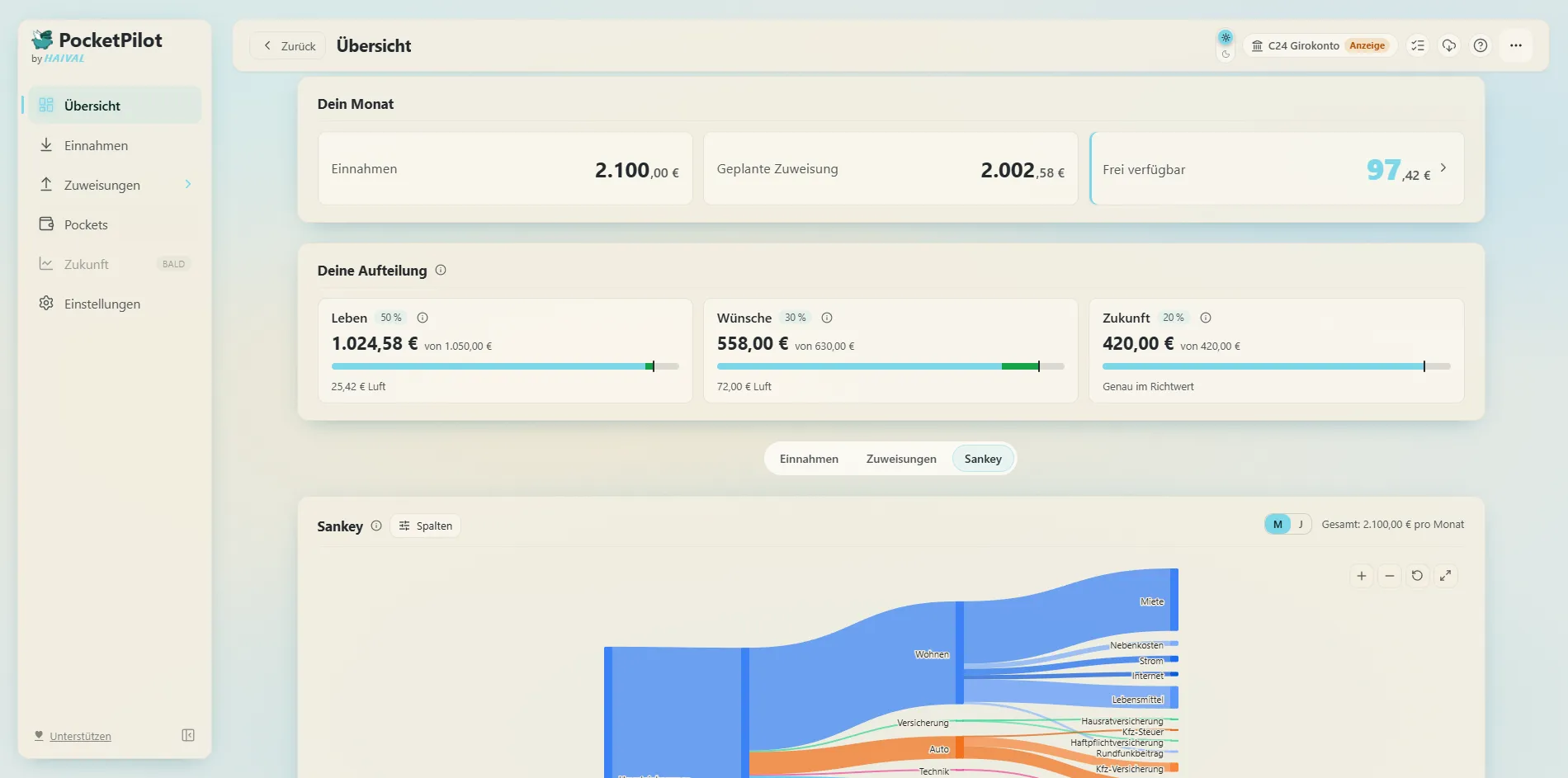
PocketPilot helps you bring your income, regular costs, savings, and personal budgets into a clear monthly plan. You can see how much to plan for each area and how much money you truly have available to spend.
If you put your plan into practice using sub-accounts or Pockets at your bank, the distribution can largely happen automatically at the start of each month. After that, you only need to make adjustments when something changes in your life.
Start PocketPilot →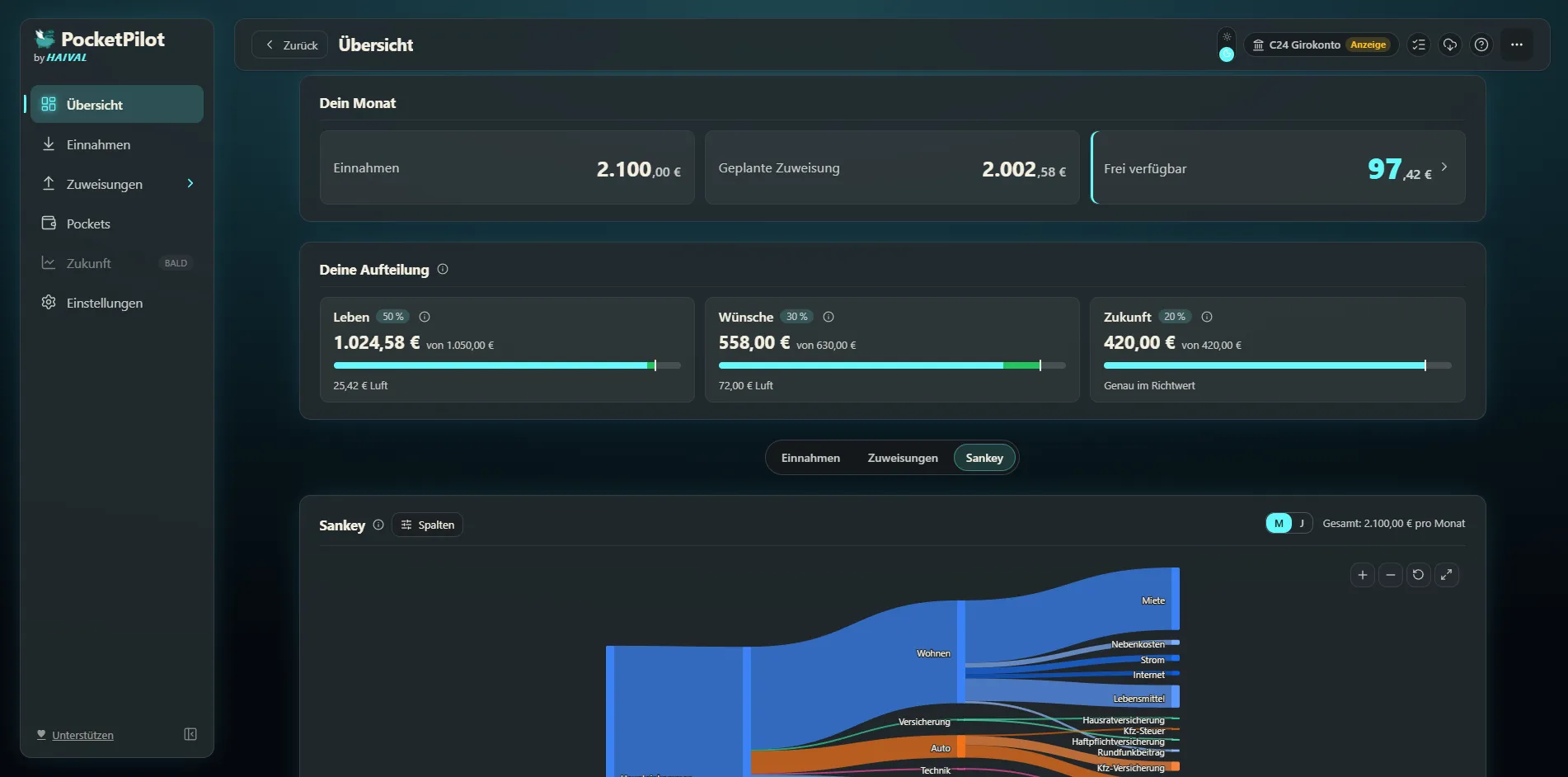
- Local in your browser
- No bank account connection required
- Split shared costs
- Start for free
No budget tracker. A plan that fits your everyday life.
A budget tracker shows you what you have spent your money on. That can be helpful, but it does not answer the most important question: How much can I spend this month without leaving myself short later?
PocketPilot helps you plan your money in advance: for regular costs, leisure, wants, shared expenses, and savings. Instead of recording every payment, every receipt, or every coffee, you create a clear structure for your money.
This way, you do not just know where your money has gone. More importantly, you know what it has already been set aside for and what you can spend with confidence.
What PocketPilot takes care of in everyday life
Keep an overview
Plan income, fixed costs, savings, and personal budgets in one place. See how your money is distributed each month and across the year.
Prepare for known costs in good time
Insurance, memberships, and other expenses that occur only once or several times a year are converted into monthly amounts. This means the money is already there when payment is due.
Know what is truly available to spend
Once regular costs, savings, and goals have been planned for, you have a clear budget for everyday life and leisure. You can spend this money without constantly working out what is still due this month.
Plan for what you want without feeling guilty
Whether it is a holiday, a hobby, technology, or a larger purchase: set aside an amount for it each month. Your wants do not become an unexpected hole in your budget; they become an achievable goal.
Account for shared costs
Do you share rent, shopping, streaming subscriptions, or other expenses? Mark costs as shared and decide how they are split. PocketPilot includes your personal share directly in your plan.
Your budget, clearly distributed
The 50/30/20 rule provides the guideline: half of your income for Needs and essential costs, 30 percent for Wants and leisure, and 20 percent for long-term saving. PocketPilot calculates this automatically from your income.
Needs
Rent, groceries, insurance, electricity, and contracts.
Wants
Hobbies, holidays, eating out, or larger purchases.
Savings & emergency funds
Your emergency fund, long-term goals, and building wealth.
With a monthly income of €2,000:
The Pocket method for everyday life
This distribution becomes practical through four Pockets. If needed, you can set them up as sub-accounts at your bank. Transfer the money once a month, and the rest of the month largely takes care of itself.
Main account
For income and flexible everyday spending.
Regular Costs
Rent, contracts, insurance, and recurring payments.
Savings goals
Holidays, hobbies, and planned purchases.
Emergency fund
A reserve for unexpected expenses.
PocketPilot gives you the plan. How you put it into practice is up to you
- with one account, several sub-accounts, Pockets, or simply as a personal budget overview.
How planning helps in practice
The annual bill
Does your insurance cost €720 per year? Plan €60 for it each month. By the time the bill is due, you will have set the full amount aside gradually throughout the year.
Your personal leisure budget
Have you planned €150 per month for leisure? You decide whether to spend it on eating out, something for your hobby, or meeting friends. What matters is not every individual expense, but your overall budget.
Shared costs
Do you pay €60 for a shared subscription but do not split the cost equally? Set the distribution you want. PocketPilot includes your share in your budget while personal expenses remain separate.
Good to know
Plan for known costs in good time
Recurring costs with monthly, quarterly, six-monthly, or yearly intervals are converted into a monthly amount.
Split shared expenses fairly
Mark expenses as shared and decide how they are split. This is useful for couples, flatshares, families, or shared subscriptions.
Local, private, no account required
Your data stays local in your browser. PocketPilot does not require a bank account connection or cloud synchronisation.
Important: If you delete browser or website data, locally stored entries may be lost. Create a backup of your plan regularly using the backup feature.
Who is PocketPilot for?
PocketPilot is for you if you want to
- organise your monthly finances without keeping a detailed budget tracker
- know how much money you can plan for everyday life, leisure, and savings goals
- prepare better for regular and irregular costs
- use a simple, local budgeting tool without an account or compulsory cloud storage
Set up in just a few steps
Start by entering your income. Then create your Pockets, plan regular costs, savings, and budgets, and see how your money is distributed in the Overview.
You can start directly with your own figures or load sample data to get to know PocketPilot first.
Why I built PocketPilot
I used to use budget trackers to keep track of my spending. That was helpful: it gave me a better sense of where my money was going. But I realised that looking at the past alone does not create a plan for the future.
What I was missing most was a simple answer to questions such as: What can I really spend this month? How much do I need to set aside for my next insurance payment, a holiday, or other larger costs? And how can I stop an annual bill from throwing my entire month off balance?
At some point, I came across the 50/30/20 rule. The idea immediately made sense to me: divide income roughly between essential expenses, personal wants, and savings or emergency funds. Not as a rigid rule, but as an easy-to-follow guideline.
At first, I built an Excel spreadsheet for it. I entered regular costs, irregular expenses, and my goals. For costs that occur yearly, every six months, or quarterly, I divided the amount into individual monthly amounts. This turned a large bill in January into a small, manageable monthly saving.
I also set a budget for things that vary from month to month - such as leisure, eating out, or my hobby. As long as I stayed within that budget, I did not have to judge or meticulously categorise every individual expense.
Later, I organised my system using separate pots and accounts. At the start of the month, the available money is distributed: one share for regular costs, one for savings and goals, and one for everyday life. Whatever remains in my personal budget can be spent with confidence because important costs have already been accounted for.
I have used this approach myself for several years. It does not solve every problem automatically, but it gives me a clear overview and makes the money available to me more predictable. Budgets can change. What matters is not getting everything perfect on the first attempt, but finding a system that actually works in everyday life.
When I told friends about it, one thing quickly became clear: not everyone wants to build a complex Excel spreadsheet, calculate annual costs themselves, or maintain a personal system from scratch. That is exactly why I built PocketPilot.
PocketPilot is designed to help bring income, regular costs, savings, and personal budgets into an understandable structure. Not as a complicated budget tracker and not as control over every little thing, but as a plan that shows what your money should do each month.